

(High-)performing organizations can be recognized by the fact that they offer high-quality products and services at attractive prices on the market and thus create real added value for their customers. If they are also innovative, perhaps even market-defining, treat their employees well, act in an environmentally conscious and socially responsible manner and grow profitably, then we are already very close to the definition of a high-performance organization.
But the question is more interesting, like such companies can achieve. Of course, this depends heavily on the respective market and industry sector. Since the beginning of digitalization, however, the framework conditions have changed fundamentally across all sectors. Digital champions with data-based, sometimes disruptive business models are shifting competitive boundaries. Technological development has strengthened the end customer's position of power, increased market transparency and shifted value creation from products to services, from hardware to software.
With the rapid development of artificial intelligence (AI) - in particular generative AI (GenAI) - a further technological leap is now imminent. AI is changing the way knowledge is generated, shared and used, making it a key enabler for innovation, decision quality and operational excellence. The pace of innovation continues to increase, while predictability and stability are decreasing.
It is therefore all the more astonishing that many companies still work as if little has changed since the industrial age: Workforces are organized in small-cell, sometimes rigid structures, decision-making processes are tough, there is little transparency and divisional interests dominate. Employees carry out what managers decide, the customer only plays a role in certain areas.
When skilled workers are scarce and the job market is good, the first top performers leave - whether out of dissatisfaction or because other organizations are more attractive. When new competitors, technological leaps or supply problems come along, many companies quickly reach their breaking point: they slow down, customer satisfaction drops, quality and motivation suffer and a downward spiral begins.
Today, speed, innovation and adaptability are more important than ever - as is the willingness to see change as an ongoing task. AI can become a decisive lever here if it is used as a tool to reduce workloads, speed up processes and improve decision-making. It supports teams in analyzing, brainstorming, communicating and automating repetitive tasks - and thus creates space for creativity, interaction and learning.
There are five key areas that management can influence directly:
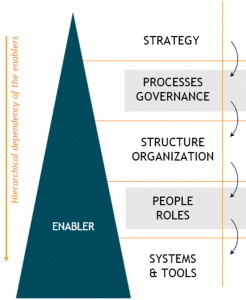
- Vision and strategy
- Processes and governance
- Organization and structure
- People and their roles
- Technology and IT
These five „enablers“ interact strongly with each other and follow a logical ranking from top (1) to bottom (5). Two examples show how important their interaction is:
Example 1:
When problems arise, people like to reorganize quickly (3) - in the hope of a quick effect. This can work if attention is paid to people and their roles (4) and both processes (2) and IT (5) are aligned with the new structure. If this synchronization is missing, the problem is usually only shifted. AI-supported analyses can help to make organizational structures and process dependencies visible at an early stage - and thus make reorganizations more informed.
Example 2:
Many companies have an IT landscape that has grown over the years with isolated solutions, workarounds and media disruptions. People keep the system running - often at great expense. When major IT changes such as cloud migrations are imminent, it often becomes apparent that processes (2) and IT (5) are not properly aligned. This is where AI can create transparency, identify weak points and accelerate complex modernizations - especially through automated process analyses or semantic data integration.
High-performance organizations start with the market and the customers. They derive their strategy (1) from this, design the process landscape (2) accordingly and only then adapt the organizational structure (3), roles (4) and technology (5).
They use AI in all these steps in a targeted manner: to evaluate market data, to model scenarios, to simulate processes or to improve internal communication. AI is therefore not an end in itself, but an integral part of strategic and operational excellence.
What all high-performance organizations have in common is a clear vision and a high degree of customer centricity. They know exactly what is needed to ensure customer satisfaction and business success - some even create new customer needs and actively shape markets.
For this to succeed, the five enablers must be designed in such a way that they enable innovative strength, speed and adaptability. In addition to a clear and communicated strategy (1), you need lean, agile processes (2), a flexible organizational structure (3), clear roles with end-to-end responsibility (4) and IT (5) that consistently supports all of this. AI can make productive contributions here in all areas - for example through process-accompanying assistance systems, data-based control or the generation of knowledge in real time.
Of central importance is the organizational structure (3) and the value-adding processes (2), which must achieve two things:
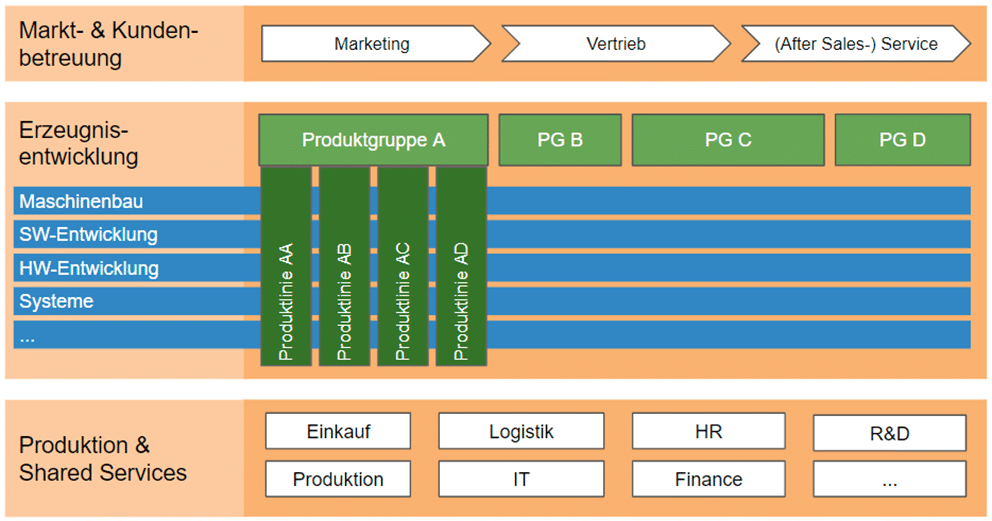
On the one hand, delivering customer-centric, fast and innovative results (e.g. in development, marketing and sales), and on the other hand ensuring efficient and process-oriented standardized workflows (e.g. in production, logistics, finance).
The challenge is to create a framework that enables both - agile dynamics and operational stability. Such hybrid organizations usually consist of four building blocks:
- Functional units ensure excellence and further development of core competencies.
- Lean-agile units work in market and customer-oriented interdisciplinary teams.
- Shared services connect both worlds, internally and externally.
- Spine ensures strategy, leadership and synergies.
AI can take on important connecting functions in this hybrid model: It networks knowledge between units, recognizes patterns in customer or process data and supports the synchronization of goals and results. Generative AI systems, for example, can support project teams in knowledge processing, documentation or communication with stakeholders - and thus reduce frictional losses.
The shift towards high-performance organizations also requires a new understanding of leadership. Trust, transparency, personal responsibility and consistency are becoming critical to success. Leadership is shifting from decision-making to enabling. AI can support managers in this - for example by providing a sound basis for decision-making, automated reports or feedback analyses - but it cannot replace them. On the contrary: the human factor is becoming more important because it provides the ethical, cultural and strategic framework within which AI can have a meaningful impact.
Even though such transformations are demanding and require a great deal of patience, companies that consistently follow this path have achieved impressive success. It is crucial to understand change as a continuous process - data-based, learning-oriented and people-centered. There will hardly be any permanent stabilization in a fixed target state; the economy and society are changing too quickly for that.
AI - especially GenAI - does not change what makes a high-performance organization, but it does, like it develops and evolves. The ability to harmonize technology, processes, people and leadership - and to focus on learning - remains crucial.
If you would like to learn more about how artificial intelligence can help organizations combine performance, agility and innovation, please contact us.
About the author
Rüdiger Schönbohm is a partner at TCI and an expert in (agile) organizational development. His work focuses on questions of strategy-led further development of organizations, mostly in a lean-agile context. He has 20+ years of management experience in global companies in the automotive and consumer industry and has worked for many years as a management consultant, project manager and agile coach.
Source cover image: © Summit Art Creations | Adobe Stock